
How to Communicate With Your Teacher: You need to P.I.N.G. them!

Last updated: February, 2026

Want to share a product or service with over 6,000 parents and educators interested in executive functioning?
Do you have a student who struggles to communicate with their teachers?
In this post, I'll share the exact email structure I've taught to students as an executive function coach so they get a positive reply and come across as responsible, not careless.
Table of Contents
Maybe you’ve heard something along these lines when you suggest they reach out to their teacher to address a missing assignment or low test grade:
I don’t want to bother my teacher.
I’ll just talk to them in class.
That assignment isn’t supposed to be graded so don’t worry about that zero.
For many parents, tutors and educational coaches, hearing these statements sounds like nails on a chalkboard.
The more they insist that the student clarify things with their teacher, the deeper the student digs in their heels in resistance.
We all know that communication is a core competency to living a productive and meaningful life.
Good communication builds relationships, strengthens families and creates peace among people and nations.
Bad communication does the opposite.
How Do We Teach Our Students to Communicate Effectively With Teachers?
This question has been the focus of my work as an executive function coach for years.
And after working with hundreds of students who struggled with missing assignments, low test grades, and endless bickering with their parents, I’ve created the P.I.N.G. methodology to ensure they can effectively communicate with their teachers.
P.I.N.G. stands for the following:
Pleasant introduction
Inform and inquire
Negotiate your needs
Gratitude for their assistance
The secret sauce of this formula is in the breaking down of communication into component parts that most students would forget unless it were explicitly explained to them.
If you prefer a video on this topic, watch this👇
When they start to use this methodology, I’ve seen many students go from “D”s and “F”s to “A”s and “B”s, while also experiencing more fulfilling relationships with teachers and parents that were once antagonistic and defensive.
What Are The Components of PING and How Does This Actually Look in an Email?
1. Pleasant Introduction
The “Pleasant introduction” can be a very simple statement that aims to lower the affective filter a teacher might have up after a long day of work.
Here is an example of one possible pleasant introduction:
Hi teacher,
I hope you are doing well.
If the student wants to add a bit of flourish, they could remark on something pertinent that happened in class recently, like so:
Hi teacher,
It was great to be a part of the discussion we had in class this week on the importance of Black Lives Matter protests worldwide. I appreciate you calling on me to share my thoughts.
By not jumping straight into a demand, the student is showing grace and tact, putting the teacher at ease and demonstrating the student has appropriate social skills.
2. Inform and inquire
Next, you’ll want to help your student “Inform and inquire” about the particular issue they are experiencing.
This usually has to do with a low-grade, a missing assignment or less than desirable outcome on a test.
Here is an example of what “Inform and inquire” could look like:
I noticed that my grade in your class is currently a (grade). My goal is to earn a (desired grade). My plan is to complete the following assignments in this order:
(Assignment I will complete first)
(Assignment I will complete second)
(Assignment I will complete third)
Is there anything else you suggest I do to work toward my goal of earning (desired grade) in your class?
Notice that I let the student choose what grade they want.
Encouraging your students to executively choose what grade they want to earn (not get) is a big piece of the executive function puzzle.
When the student is executively choosing their own goal you will find they are much more likely to follow through on taking actions to reach their stated goal.
By informing the teacher they are aware of their current standing, it also alerts the teacher that this student cares about their standing in the class and desires to do better.
This small step often has a ripple effect and improves the overall student rapport between student and teacher.

3. Negotiate their needs
After “Informing and inquiring” about the approach to succeeding in the class, it will be important for a student to “Negotiate their needs.”
The way this is done is by using a request in the form of a question:
Will I be able to earn full credit if I complete these and submit them to you by (choose date)?
If you don’t ask, you can’t receive!
Knowing that it is ok to negotiate and ask for something they want is the beginning of self-advocacy skills that all parents and teachers wish upon their students.
I also have them choose the date by which they can submit the missing work in order to continue to strengthen their executive ownership over the process and “own” each step of the way.
Remember, many students with limited self advocacy skills also have time management challenges, so it is ok to encourage them to choose an extended deadline (rather than a short one) and tell them it is best to “undersell and overdeliver”.
4. Gratitude for their assistance
Finally, encourage the student to end with “Gratitude for their assistance.”
This mirrors the pleasant introduction and shows the teacher that the student has the soft skills necessary to build relationships and that they value their teacher’s input.
How nice is it for a teacher to get an email like this, rather than a parent stepping in for the child?
Thank you for your guidance ,
(Your Name)

What's Next?
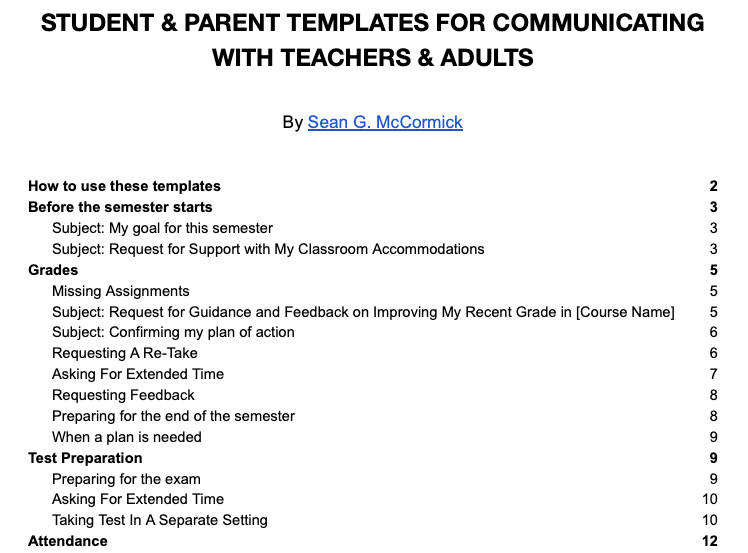
If you are looking for a range of communication templates that students can use to connect with their teachers, please download our free Templates For Students To Communicate With Teachers and Adults.
I hope this helps your student communicate clearly and confidently so they can reach their goals and find joy!
If you'd like to schedule a free consultation to discuss a plan to support your middle, high school or college student in learning how to implement this system, you can book a no-cost inquiry call with our team.
FAQs
What if the teacher never replies?
Have the student wait 24–48 hours, then send a short follow-up that restates the question and includes the original email below it.
If it’s still crickets, they should talk to the teacher right after class or during office hours and say, “I sent an email—could you help me confirm the plan?”
What if my student is terrified of sounding “annoying” or “stupid”?
That’s exactly why P.I.N.G. works: it’s respectful, clear, and shows effort without being needy.
You can help by practicing the email out loud once, then having them send it themselves.
How do we use this without asking for special treatment?
Keep the “Negotiate” part simple and realistic: ask what’s possible and offer a specific plan and deadline, not an emotional plea.
The tone is “I’m taking responsibility—can you tell me the rules?” not “Please rescue me from my choices.”
The Bottom Line
Use the P.I.N.G methodology to effectively email teachers in a way that shows responsibility, emotional intelligence, and the desire to do better.
To recap, P.I.N.G stands for:
Pleasant introduction
Inform and inquire
Negotiate their needs
Gratitude for their assistance
Hope this helps 🤙🏻
This article is a part of the larger category of:
Related articles:
P.S. If you want to work on executive function skills with your students, consider joining hundreds of other educators and parents who have completed my Semester Success Blueprint Course. In less than 2 hours, this comprehensive course will teach you and your student the system I developed to help hundreds of students learn how to manage school effectively and raise their self-awareness and engagement with school.
About Me

Hey! I'm Sean 👋
I'm a former public school special education teacher who realized that executive function skills are more important than knowing when George Washington crossed the Potomac.
Since then, I've made it my mission to teach anyone who will listen about how to develop these key life skills.
In 2020, I founded Executive Function Specialists to ensure all students with ADHD and Autism have access to high-quality online executive function coaching services. We offer online EF coaching and courses to help students and families.
Realizing I could only reach so many people through coaching, in 2021 I started the Executive Function Coaching Academy which trains schools, educators, and individuals to learn the key strategies to improve executive function skills for students.
In 2023, I co-founded of UpSkill Specialists, to provide neurodivergent adults with high-quality executive function coaching services.
When not pursuing my passions through work, I love spending time with my family, getting exercise, and growing my brain through reading. You can connect with me on LinkedIn.
Want me to speak on executive function skills at your event? Learn more about my speaking topics here.